

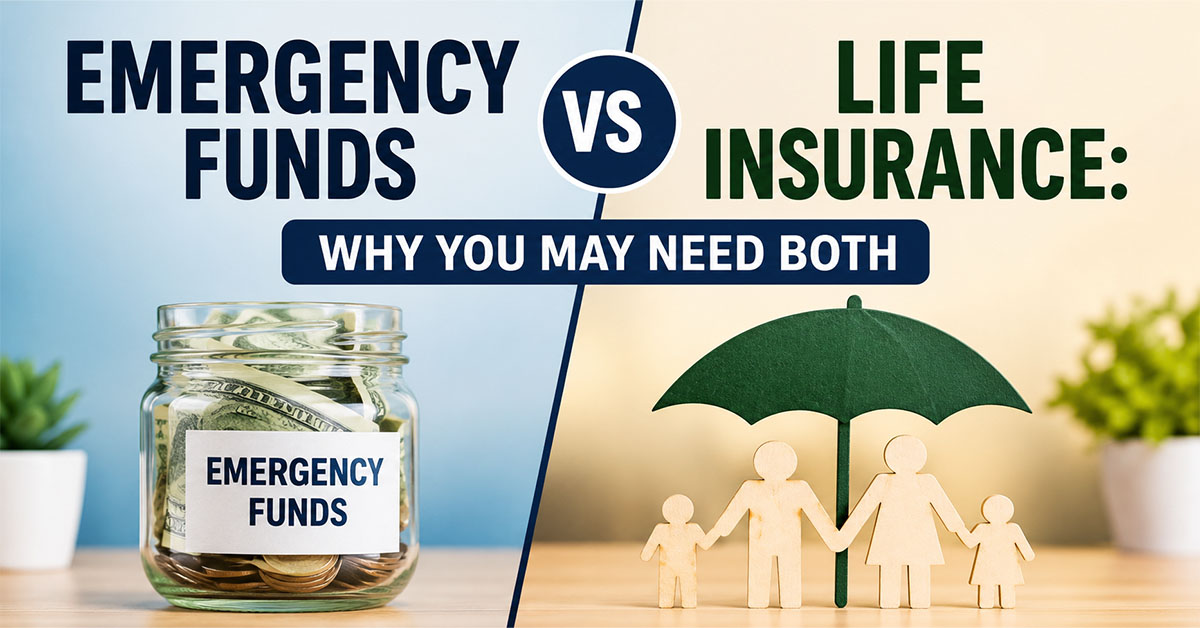
Most expats in Dubai build their financial plan around what they can see: monthly expenses, savings targets, maybe a rough idea of how long they plan to stay. What often gets left out is what happens if something goes sideways in a way that savings alone can’t fix. Two tools address this directly: emergency funds and life insurance. Two tools come up most often in that conversation: emergency funds and life insurance. People sometimes treat them as alternatives, as though having one means they don’t need the other. That thinking can leave some significant gaps in your financial plan. The best life insurance in UAE is not a replacement for savings; it works alongside them, with each covering the risks the other cannot.
What Emergency Funds Are Actually For
An emergency fund is money you keep liquid and accessible for short-term, unexpected expenses. A sudden medical bill, a car repair, a gap between jobs, an unexpected flight home. In Dubai, where monthly costs are substantial and many expat households run on a single income, financial advisors typically recommend three to six months of expenses held in a savings account you can reach quickly.
Emergency funds are excellent at handling:
- Temporary income disruption, such as a job change or short-term illness
- Unexpected one-off costs that would otherwise go on credit
- Small financial shocks that don’t require restructuring your entire financial plan
- Buying time while you stabilise a situation without taking on debt
What emergency funds cannot do is replace your income permanently. They cannot pay out to your family after you’re gone. They cannot cover a critical illness diagnosis that keeps you out of work for two years. And depending on how long it takes to build them, they may not exist at all during the early years of your career when your financial responsibilities are already at their highest.
Why You Need Life Insurance
Life insurance in Dubai addresses the risks that no savings account can absorb. It is not designed for small, manageable disruptions. It is designed for the events that would permanently alter your family’s financial trajectory.
Consider what happens in Dubai if the primary earner in a household passes away unexpectedly. Rent doesn’t pause. School fees don’t pause. Loan repayments don’t pause. The family may have three to six months of expenses saved, and that will help in the immediate term. But three months of savings is not a financial plan for the years that follow. Life insurance in Dubai fills that space, providing a lump sum that your family can use to stabilise, pay off debts, continue children’s education, or return home if they choose.
Beyond death, good life insurance policies in the UAE offer coverage that extends to serious illness and permanent disability. These are scenarios that are statistically more likely to affect a working adult than death during their peak earning years, and they carry just as much financial weight.
Life Insurance in Dubai matters for expats in particular because:
- There is no state welfare or social safety net in the UAE for most residents
- Extended family support networks are usually thousands of kilometres away
- Gratuity payouts, while helpful, are not structured to sustain a household long-term
- Employer-provided group cover is typically limited to one or two years of salary, which falls short of real long-term needs
How the Two Work Together
Think of emergency funds and life insurance as operating on entirely different time horizons and risk scales.
Your emergency fund handles the expected unexpected: things that are inconvenient, disruptive, and costly but ultimately survivable, financially. Your life insurance handles the catastrophic: scenarios where the financial damage is too large and too permanent for savings alone to address.
Here’s a simple way to see how they complement each other:
| Situation | Emergency Fund | Life Insurance |
|---|---|---|
| Job loss for 3 months | Covers living expenses while you find work | Not triggered |
| Car breakdown or home repair | Covers the cost without going into debt | Not triggered |
| Death of primary earner | Provides short-term bridge | Provides long-term financial security |
| Critical illness diagnosis | Covers immediate costs | Pays lump sum for treatment and income loss |
| Permanent disability | Partially covers short-term expenses | Replaces lost income long-term |
The key insight is that neither tool makes the other unnecessary. A family with strong life insurance but no emergency savings will still struggle through a three-month job gap. A family with a solid emergency fund but no life insurance is one major health event or early death away from a financial crisis.
Common Mistakes to Avoid
Treating one as a substitute for the other. Emergency savings cover short-term disruption. Life insurance covers long-term catastrophe. They are not interchangeable.
Waiting until the emergency fund is “complete” before buying insurance. Building a full emergency fund can take years. During that time, your family is unprotected against the scenarios that matter most. Life insurance in the UAE is priced based on your age and health at the time of application. A 32-year-old in good health pays considerably less than the same person applying at 42 with a few medical disclosures on record. Every year you wait, the cost of the same cover goes up.
Relying solely on employer-provided coverage. Many expats in Dubai have some group life insurance through work. Most of it is insufficient. It also disappears the moment you change jobs or leave the country, which is a risk worth taking seriously.
Underestimating how much emergency savings you actually need. Dubai is an expensive city. Three months of expenses here is not the same figure as three months of expenses somewhere with lower housing and schooling costs. Your target savings number should reflect your actual monthly outgoings.
Where to Start
If you’re starting from zero, the practical sequence is:
- Build one to two months of expenses in accessible savings first, enough to handle minor disruptions
- Get life insurance in place as early as possible, because that protection can’t wait for your savings to mature
- Continue building your emergency fund to the recommended three to six months
- Review both regularly as your income, dependents, and responsibilities change
The exact shape of your financial plan depends on your age, income, family situation, and goals. A personalised conversation will get you to the right answer faster than any general framework.
Planning for the Long Term
Emergency funds and life insurance solve for different versions of uncertainty, but both are part of the same underlying goal: making sure your family’s financial position is never entirely at the mercy of things outside your control.
In Dubai, where financial planning requires navigating employer benefits, cross-border assets, and a cost of living that doesn’t accommodate much slack, having both in place is not a luxury. It’s sound planning. Most people who sit down to review their coverage properly find they have gaps they hadn’t accounted for in savings, in insurance, or usually both. A retirement plan built around your actual situation in the UAE is the natural next step once the foundational protection is in place, and it’s where a 21-year conversation about what expats here actually need tends to point.
📅 Book a Free Call — We can connect to discuss this in detail.
For greater clarity on the above, kindly consult your advisor for further information.